


It’s a common worry for homeowners: you find a refrigerant leak in your evaporator coil, but your 410A condenser is only five years old. You don’t want to buy an entirely new HVAC system—but you’ve heard the new 410A rules might force your hand.
The short answer? You can still repair your R‑410A system. Here’s exactly how the current 410A regulations apply to each major HVAC component in your home.
What the New 410A Rules Mean for Homeowners
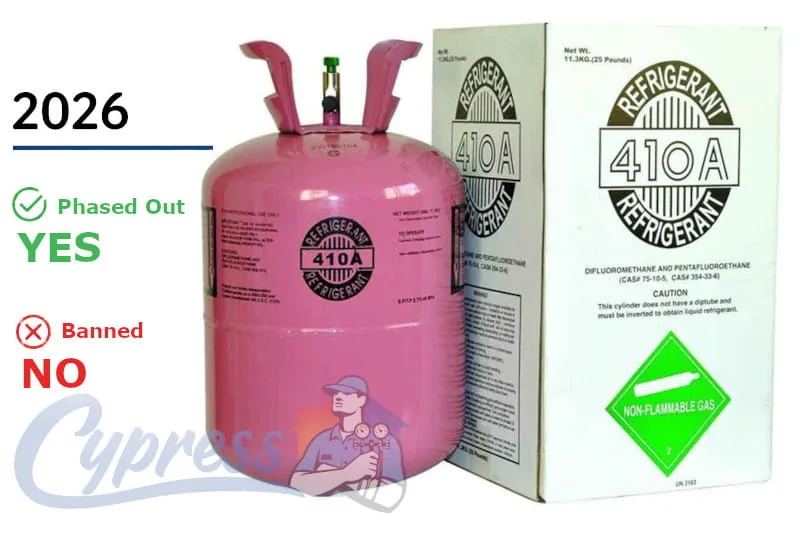
The EPA’s transition to lower‑GWP refrigerants (such as R‑32 and R‑454B) mainly affects the manufacturing of brand‑new HVAC systems. These rules do not ban the repair of existing 410A equipment.
If you already own a 410A air conditioner or heat pump, current regulations are designed to let you keep it running safely—at least for now.
If Your Evaporator Coil Fails
If your indoor evaporator coil is leaking but your outdoor 410A condenser is still in good shape, you can replace just the coil with a new 410A‑compatible service coil.
This is a standard repair, and 410A evaporator coils are still widely available as service parts.
If Your Condenser Fails
If your outdoor condensing unit fails, the situation is more complex—but still manageable.
It is still legal to replace only the 410A condenser if stock is available. As long as it matches your existing indoor coil, the system remains both legal and safe.
However, 410A condensers are becoming harder to find, and inventory is shrinking quickly.
Dry charge equipment will possibly be available in the future. “Dry ship” simply means the condenser is shipped without refrigerant.
Why Compatibility is King
Even though 410A repairs are still allowed, compatibility rules are strict—and for good reason.
No Mixing Refrigerants
You cannot mix refrigerants across components. For example, you cannot connect a new R‑454B evaporator coil to an older 410A condenser. The operating pressures and lubricating oils are different, and mixing them can damage the system or create safety risks.
What About the Furnace or Air Handler?
The furnace or air handler simply moves air, so it often does not need to match the refrigerant type. In many cases, you can replace a furnace or air handler without changing your 410A air conditioning system, as long as the equipment is physically compatible.
Summary: What 410A Rules Allow You to Replace
| If this part breaks… | Can you replace just this part with 410A? | The Verdict |
| Evaporator Coil | Yes | Standard repair; R-410A coils are still available as service parts. |
| Condenser | Yes | Legal, but inventory is shrinking fast. |
| Furnace | Yes | The furnace doesn’t use refrigerant and usually doesn’t need to match. |
| Heat Pump | Yes | Similar to a condenser; service units are allowed for existing systems. |
The Bottom Line on 410A Repairs vs. Replacement
If your 410A system is relatively young, replacing a single component—such as an evaporator coil—is a perfectly reasonable way to extend its life. You are not being forced into a $15,000 system replacement just because of one leak.
However, as 410A refrigerant becomes more expensive and parts become harder to find, there is a tipping point where repeated repairs cost more than upgrading to a modern, high‑efficiency system using R‑32 or R‑454B.
Navigating 410A rules doesn’t have to be a headache. If you’re facing a 410A repair decision, Cypress Heating & Air Conditioning can help you compare the real cost of fixing your existing system versus upgrading—so you can make a confident choice without overspending. Contact us today.


